SpriteOrbit

Blender extension · Pre-release

Author in 3D. Ship as sprites.

Bake rigs, meshes, object hierarchies and Collections into directional sprite atlases with animation data, render passes, shadows and safe Bake What Changed — directly in Blender.

DIR
1 / 2 / 4 / 8 / 16
SUBJECT
Rig / Mesh / Collection
OUTPUT
Atlas + JSON
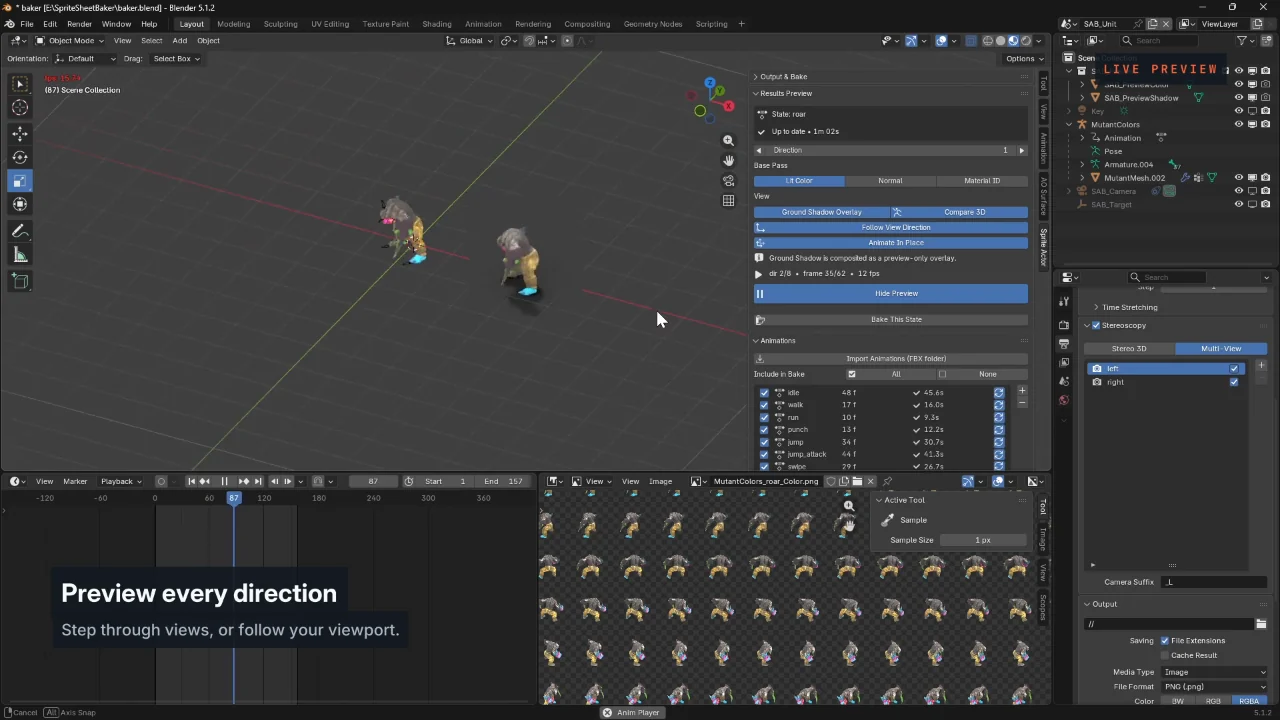
SpriteOrbit directional preview beside the source 3D model

The production problem

Sprite production gets expensive when every source change repeats the pipeline.

A manual workflow works until animation count, directions, data passes and source iterations start multiplying. SpriteOrbit is designed to remove that repeated production work.

A new animation
More rendering, framing and export work to repeat and verify.
A material or asset change
A small source edit can trigger a much broader rebake than the change actually requires.
More directions and runtime data
More views and passes multiply the outputs that need to stay consistent.
Runtime needs more than PNGs
Timing, directions, framing and motion need a consistent interpretation on the game side.

Workflow

One Blender workflow from 3D source to sprite actor.

SpriteOrbit keeps actor setup, animations, camera, preview, baking and metadata in one repeatable process.

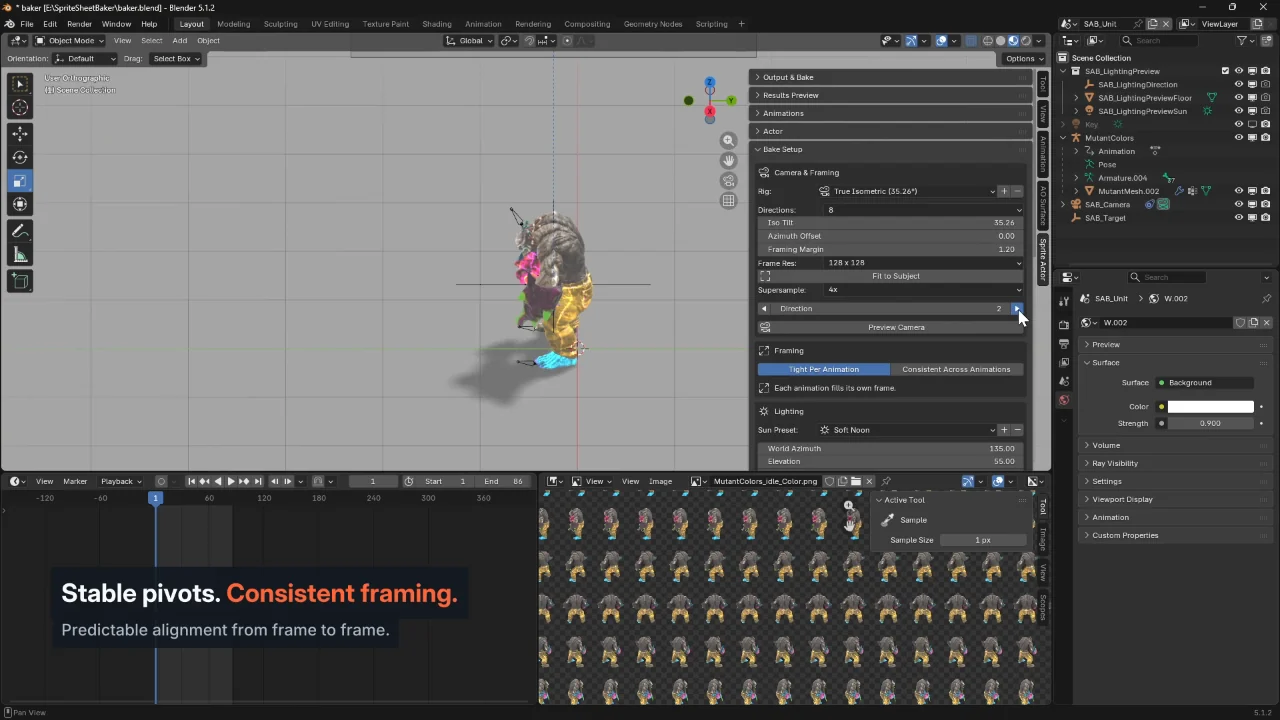
SpriteOrbit Blender UI with bake settings and atlas preview
  1. 01

    01 Select Subject

    Rig, Mesh, object hierarchy or Collection.

  2. 02

    02 Add animations

    Actions, FBX import or marker-based splitting.

  3. 03

    03 Configure camera

    Directions, projection, framing and resolution.

  4. 04

    04 Preview

    Preview Camera, framing and Compare 3D before the expensive bake.

  5. 05

    05 Bake

    Atlases, passes and metadata ready for the next production step.

Real product capture

See SpriteOrbit running directly inside Blender.

A short capture from the current workflow shows the real UI, directional baking and product output.

Directions & camera

Choose the directional fidelity your game actually needs.

Control view count and projection while framing stays consistent between preview, measurement and final bake.

1 / 2 / 4 / 8 / 16

Direction counts that scale with the game style and atlas budget.

Orthographic + Perspective

Orthographic remains the default workflow; Perspective is optional.

Framing

Silhouette measurement, padding and per-animation sizing reduce wasted space.

Preview + Compare 3D

Check framing and direction before starting the bake.
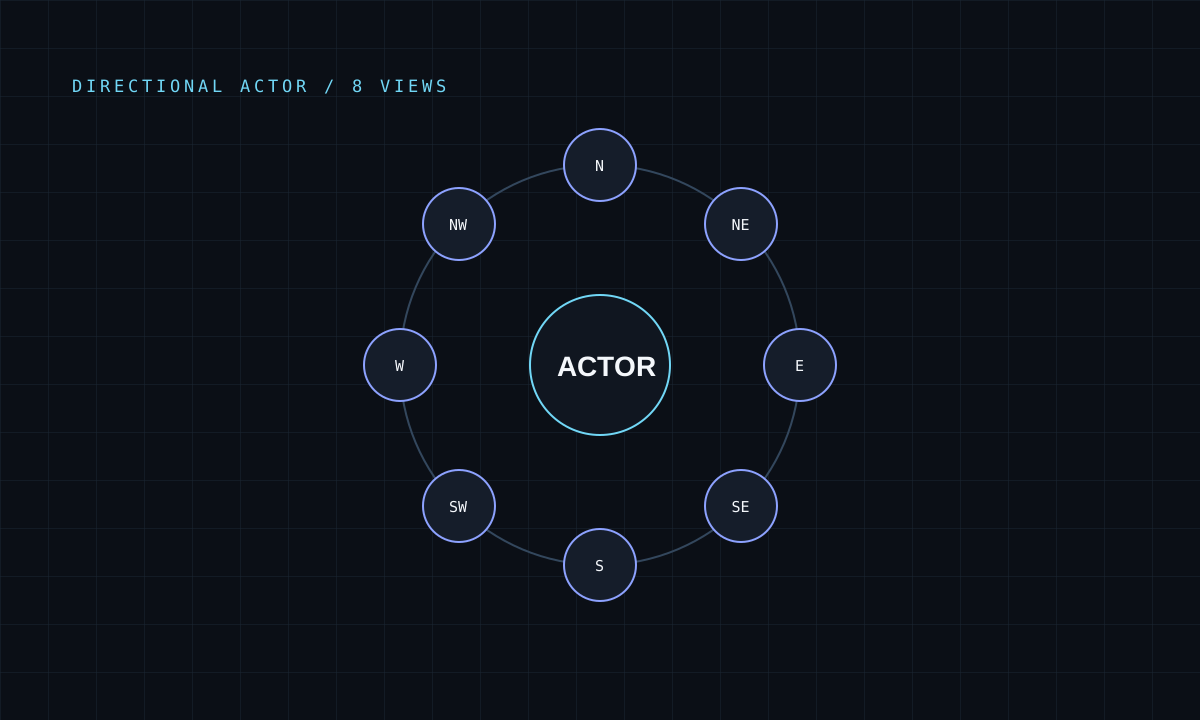
Eight-direction camera layout around the actor

Subjects

Use the assets you already have.

The same pipeline handles animated rigs and static or transform-animated objects.

Armatures / rigs

Animated characters with Actions, NLA-safe evaluation and root motion.

Subject docs

Mesh / Empty

Single meshes and object hierarchies without requiring a rig.

Collections

A Collection can be the Subject together with nested collection content.

Static Snapshot

A static object can be baked as a one-frame state.
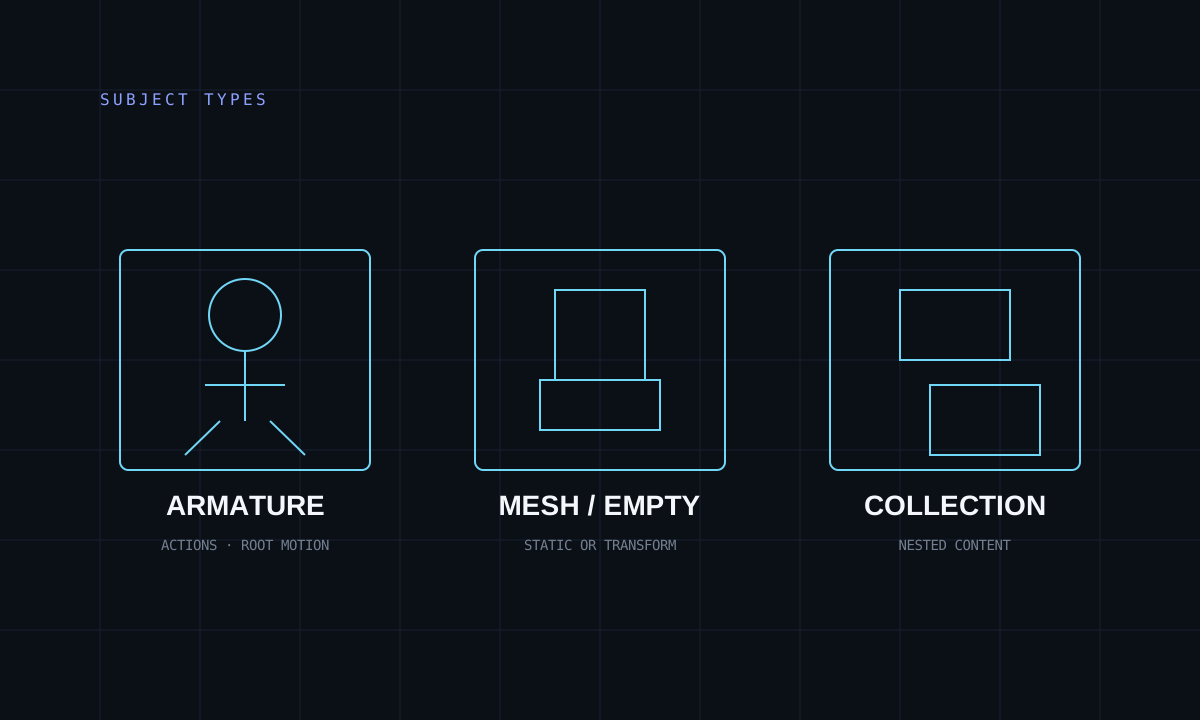
SpriteOrbit Subject types: Armature, Mesh and Collection

Animation workflow

Animation stays part of the actor instead of becoming post-render bookkeeping.

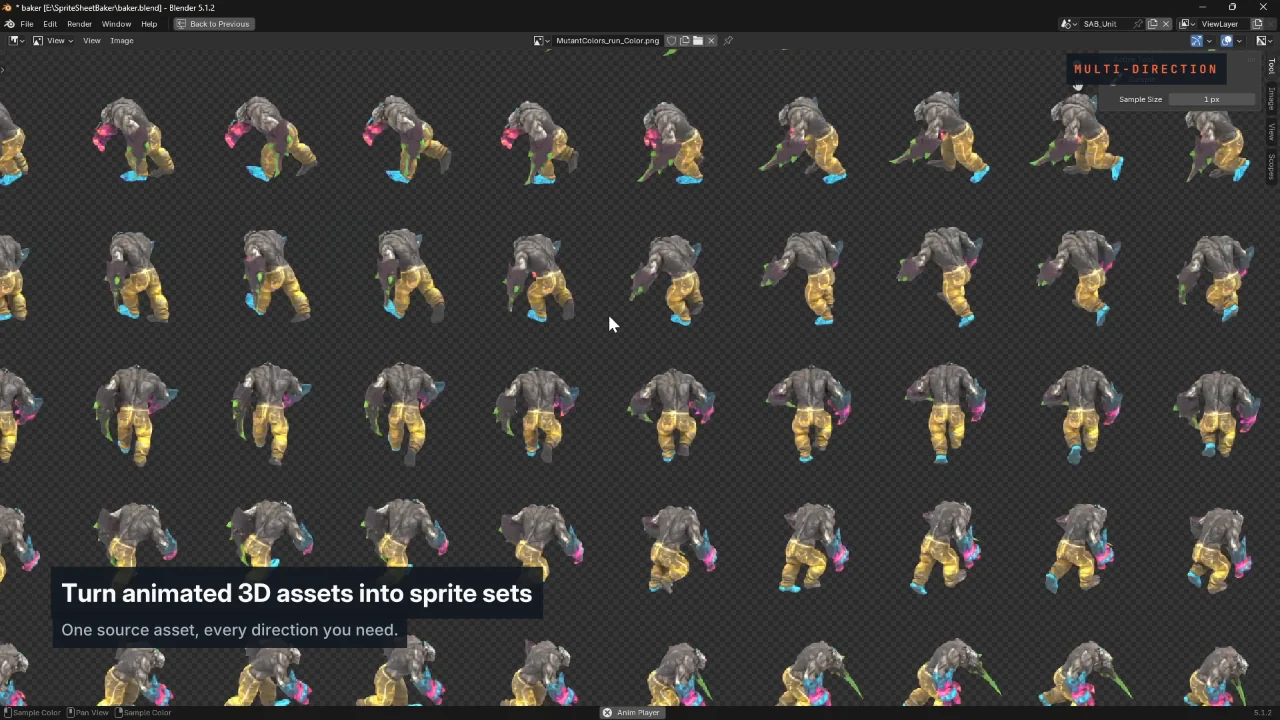
Real sprite set baked by SpriteOrbit in Blender

Multi-select FBX

Import selected FBX clips instead of entire folders.

Split by Markers

Split a long timeline into separate states using markers.

Loop / one-shot

Automatic detection helps prevent attacks or deaths from looping by mistake.

FPS & frame range

Each state can carry its own FPS and frame range.

Root motion

Locked in Cell, Locked in Cell + Height and Travel in Pixels cover different runtime workflows.

NLA-safe

NLA tracks do not silently blend into the Actions being baked.

Output passes

Bake runtime data alongside color.

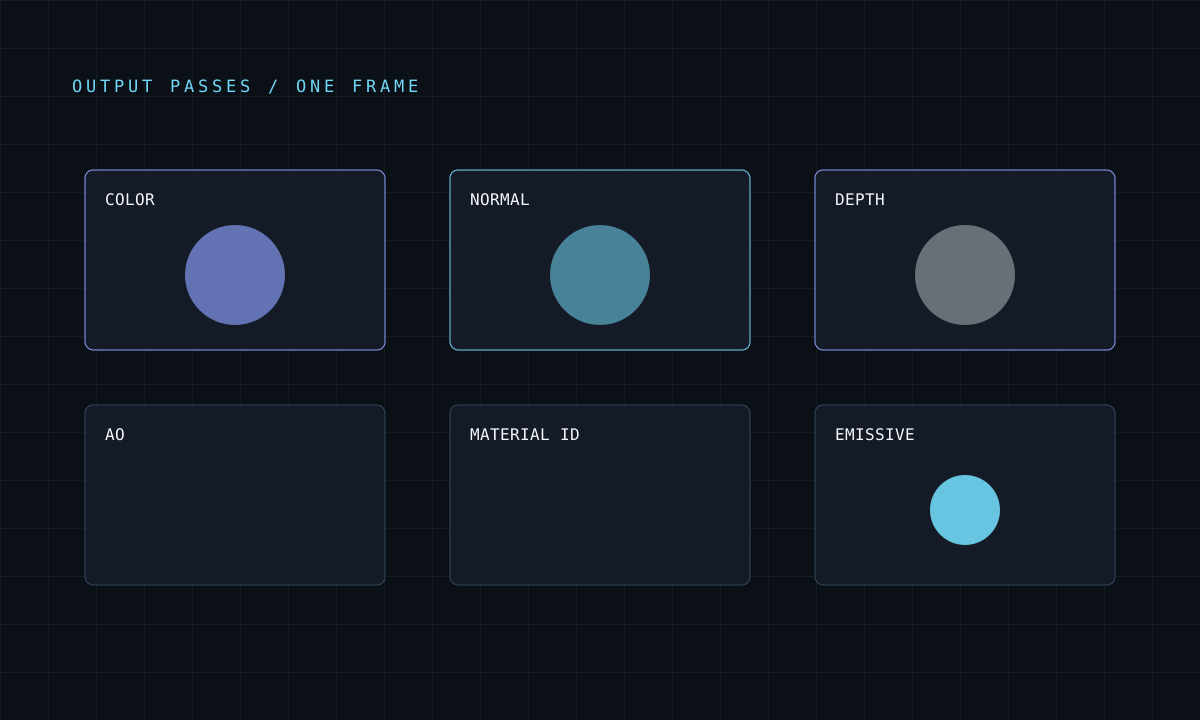
Optional data can drive engine-side materials and effects. A runtime does not need to consume every pass.
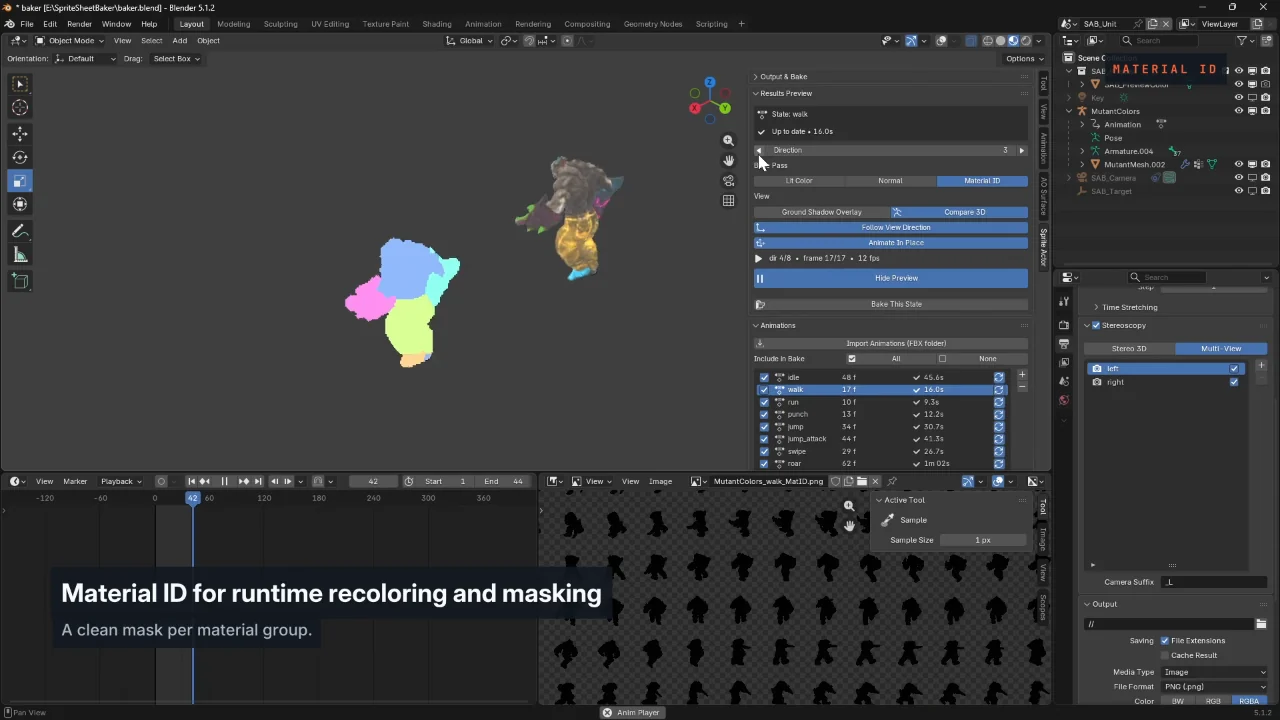
Real Material ID preview generated in SpriteOrbit
SpriteOrbit pass map showing Color, Normal, Depth, AO, Material ID and Emissive

Lit Color + Ground Shadow

Lit Color is the main atlas; Ground Shadow can be delivered separately or baked into the color output.

Pass docs

2D Normal + Material ID

View-space 2D Normal for runtime lighting and Material ID for material masking.

Emissive + Roughness

Emission mask and source roughness for downstream shading.

AO + Depth

Actor-local ambient occlusion and normalized linear depth with reconstruction range.

Bake What Changed

Change one thing — not the entire actor.

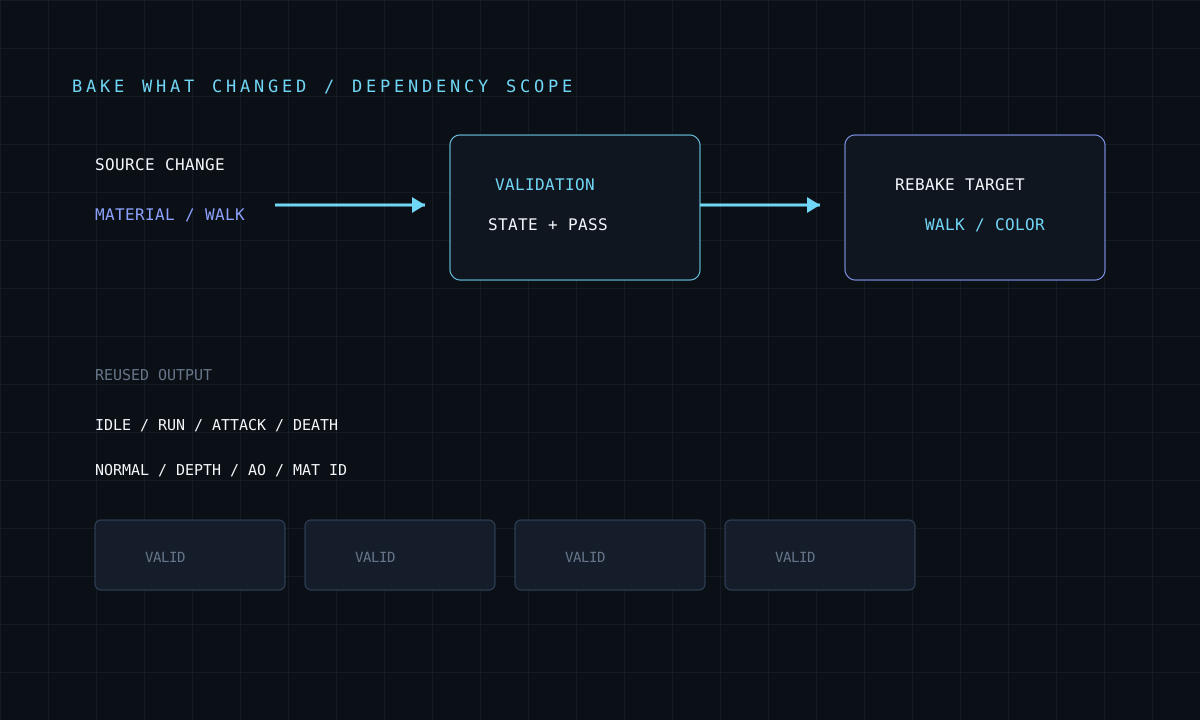
SpriteOrbit tracks output validity per state and pass. Compatible output can be reused safely instead of rendering the entire actor again.

Full rebake
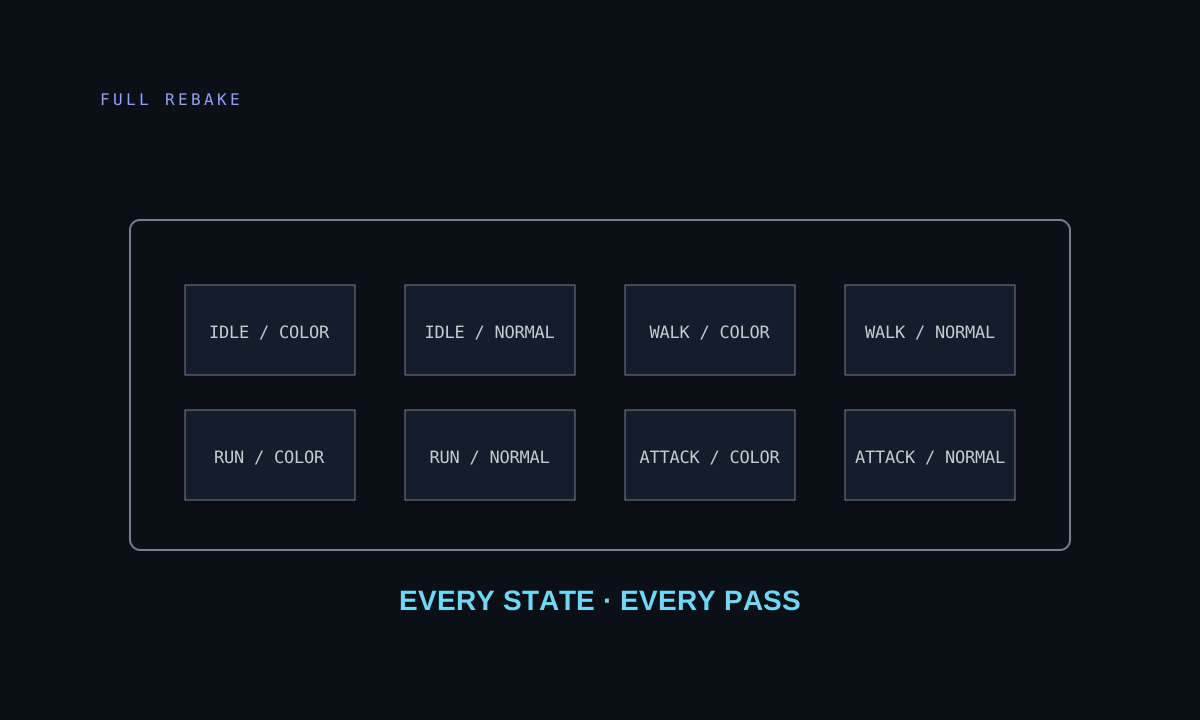
Full rebake of every state and pass

Bake What Changed

Bake What Changed dependency scope diagram

Per-state

Changing one state does not need to rebuild the full animation set.

Per-pass

A Color-specific change does not need to invalidate every auxiliary pass.

Validated reuse

An existing atlas is reused only when it still matches the current contract.

Pipeline

The output has a contract, not just file names.

Documented engine-ready JSON format. Unity integration is in validation; full Unreal integration is not currently advertised.

JSON manifests

States, timing, directions, camera, framing and pass references.

Root-motion metadata

Stabilized modes export the data required to reapply motion outside the sprite.

Documented format

SpriteOrbit uses a versioned format contract instead of requiring consumers to guess from file names.
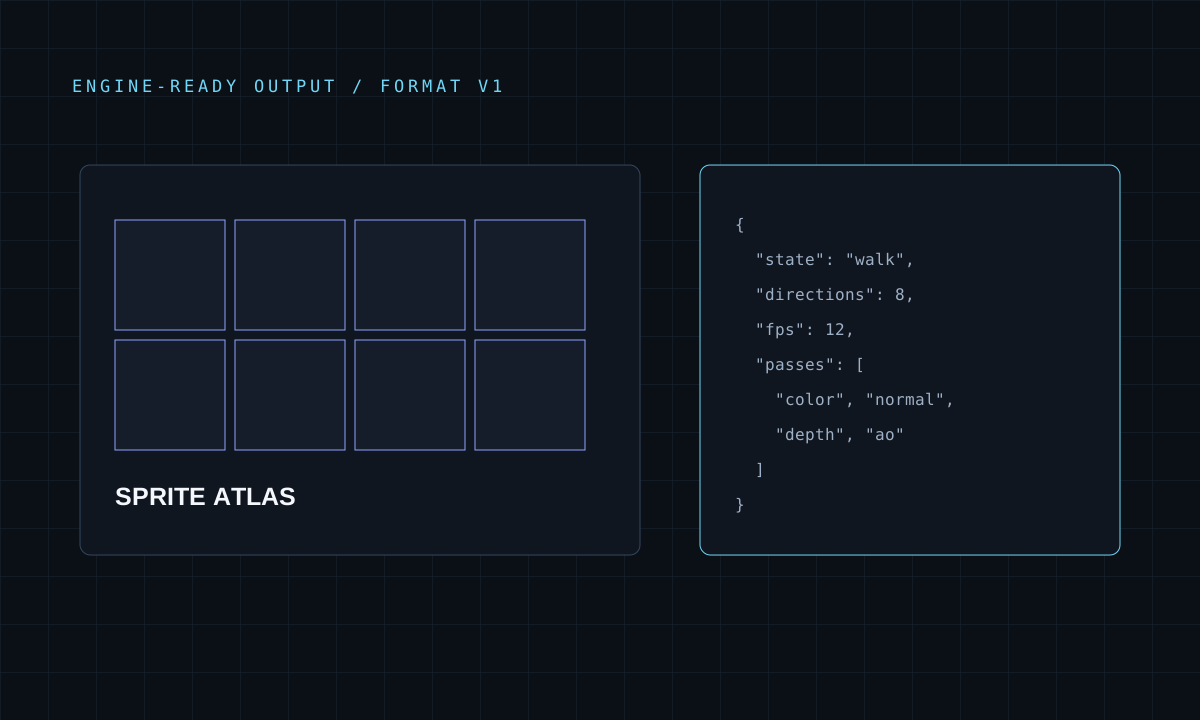
Sprite atlas and versioned JSON manifest

Compatibility

Compatibility claims based on release testing.

Why a dedicated pipeline?

Common manual work SpriteOrbit is designed to reduce.

Not every manual pipeline has every problem below. These are common places where automation starts saving time and reducing drift.

Camera & framing
Manual: repeated setup and checking. SpriteOrbit: one directional camera workflow shared by preview and bake.
Animation clips
Manual: render and describe clips separately. SpriteOrbit: state-based workflow with timing and loop behavior.
Auxiliary passes
Manual: every extra output adds more synchronization. SpriteOrbit: passes come from the same actor setup.
Source changes
Manual: it is easy to rerender too much. SpriteOrbit: Bake What Changed targets stale states and passes.
Root Motion
Manual: motion must be reconciled with pixels and runtime. SpriteOrbit: motion modes and root_delta are part of the export contract.
Output interpretation
Manual: the runtime needs custom naming/layout assumptions. SpriteOrbit: the manifest describes the structure explicitly.

Use cases

When 3D authoring is useful but the runtime should stay sprite-based.

RTS / strategy
Many units, readable directions and controlled runtime cost.
Isometric / ARPG
Directional characters authored from existing 3D assets and animations.
Colony / management
Build large unit libraries without manually rendering every frame.
Autobattler / survivors-like
A sprite-actor pipeline where full runtime 3D is unnecessary or too expensive.

SpriteOrbit Waitlist

Get notified when SpriteOrbit is ready.

Joining records your interest in SpriteOrbit. The separate consent below allows Trueway to email you about launch, beta access and meaningful product updates.

Product interest and email consent are stored separately. You can withdraw consent later. Details: privacy policy.

FAQ

The main questions before adopting it.

Do I need a rig?
No. SpriteOrbit supports Armatures, Mesh subjects, object hierarchies and Collections. A rig is only required for skeletal animation.
How many directions can I bake?
1, 2, 4, 8 or 16 directions.
Does it support root motion?
Yes. Locked in Cell, Locked in Cell + Height and Travel in Pixels cover different motion workflows.
Which passes are available?
Lit Color, Ground Shadow, 2D Normal, Material ID, Emissive Mask, Ambient Occlusion, Roughness and Depth.
Does it work with Unity?
The format is engine-ready, and the Unity integration exists but is still being validated before a full public support claim.
Does it work with Unreal Engine?
The format can be integrated with engines, but a complete Unreal importer/runtime is not currently advertised as a finished feature.
Is this a full spherical impostor?
No. Current SpriteOrbit is a directional sprite-actor baker using azimuth sampling. Full hemisphere/sphere impostors are outside the current scope.
How is it different from a normal sprite-sheet renderer?
SpriteOrbit combines animation states, root motion, framing, render passes, metadata and selective rebaking in one pipeline.
Where is the full usage documentation?
Installation, first bake, Subjects, motion, passes, export and troubleshooting live in the dedicated documentation.

Pre-release

SpriteOrbit is in pre-release.

The product page and release build are being prepared in parallel. There is no fake purchase button before a real marketplace destination exists.

Join the waitlist

Record product interest and launch-update consent in one place.

SpriteOrbit waitlist

Need a custom production tool?

Tools & Automation is the separate service for custom tools, integrations and automation built around a specific production pipeline.

Explore Tools & Automation

Question about SpriteOrbit?

Before launch, product questions and support go through Trueway contact. Include your Blender version, workflow scope and the issue you want to verify.

SpriteOrbit contact
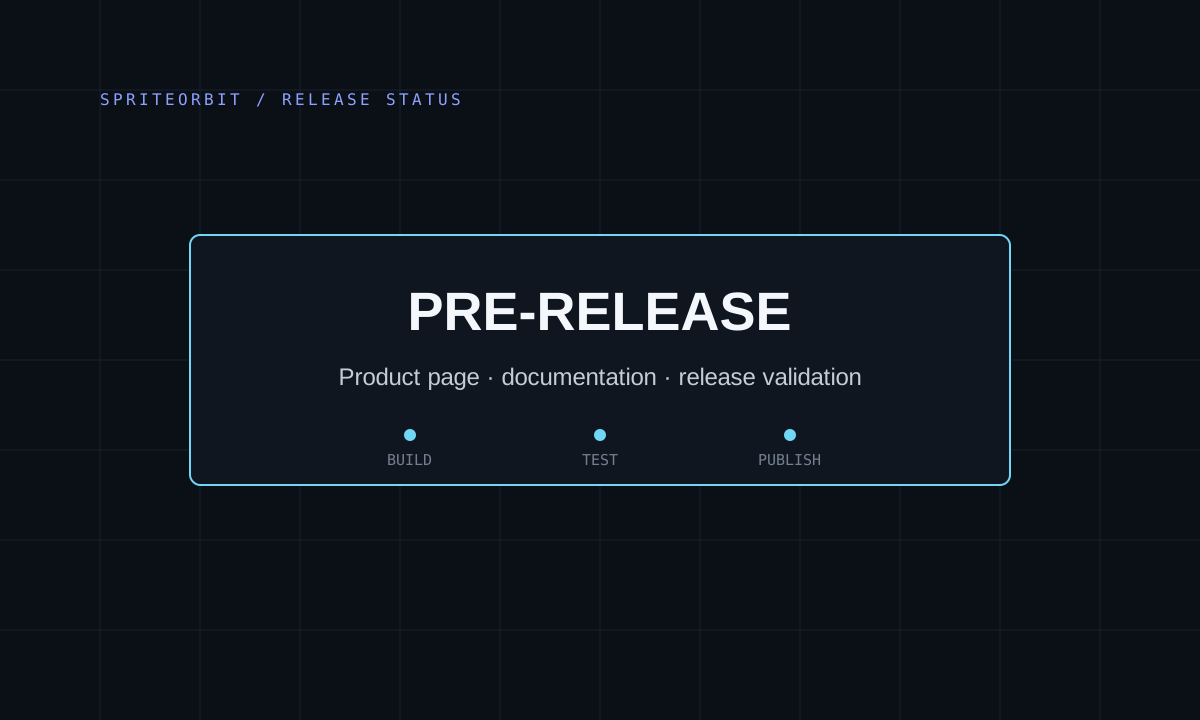
SpriteOrbit pre-release status